Saturday, July 18, 2015

Yorktown, VA

Whew! We are so glad to be back at our motorhome.  The temperature today is 90 degrees and the humidity is 64%.  Not a great day to be outside walking around.  I have not written about the weather lately and that’s because it has been so pleasant (low 80’s and low humidity) and only an intermittent rain shower during the night or early morning.  We are told the remainder of the weekend will be the same as today.   Time to find some indoor activities to do on our last day here in the Williamsburg area.

Our venture today is to Yorktown , the third city of the historic triangle in this area.  Yorktown was founded in 1691 and was a busy 18th century tobacco port.  It is best remembered; however, for the Siege of Yorktown which ended the Revolutionary War.   Less than 100 years later, the town was again under siege when Union General McClellan landed his troops at Fort Monroe in 1862.

Yorktown overlooks the York River and is the home of many charming shops, restaurants and galleries along with a sandy beach along the riverwalk where you can enjoy sunbathing and swimming in the River. 


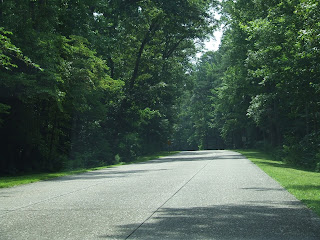
To arrive in Yorktown, we again take the Colonial Parkway driving along the treed lined road soon coming in site of the York River and this large naval ship at the end of a long pier. 

Yorktown offers two major historic sights to take in – Yorktown Victory Center – a museum that chronicles the American Revolution through exhibits and the Yorktown Historical National Park – a park service center with short video entitled “Seige at Yorktown” about the end of the War, a self guiding driving brochure taking you to all the battles sights and/or a guided park ranger led tour of the battlefield. 

We watch the video at the Center and then take the self guided tour of the various sights including the Augustine Moore House where officers of both the American and British armies negotiate the surrender terms for Cornwallis’s army. 

The  table where the negotiating took place.

After touring the Battlefield, we return to the Visitor Center where we take the free shuttle which stops at various places in the charming town of York.  I am disappointed that a museum with history of the Chesapeake Bay is closed.  Taking the Shuttle up the hill, we alight at Historic Main Street which is the old part of Yorktown where we stop in at the York County Historical Museum which is housed in the basement of the building and on the first floor is a shop full of locally handmade items of every assortment.  I was really impressed with the quality and variety of items for sale and purchased a small quilted wall hanging for the RV. 


An interesting old building in this area is the Custom House with wood planks on the floor about 12 inches wide and a couple of inches thick in order to hold the multitude of items that were brought to the House for taxation.   A lovely elderly lady wants to give me the long version of the history of the building but since Ron is waiting outside in the heat, I politely say that my husband is waiting outside and I just want to take a quick browse.  She is very gracious about it. 


We walk around a bit more, but the heat and humidity have taken a toll on our stamina so we take a few more pictures and head back to the Shuttle Stop.  At the Grace Episcopal Church and Cemetery we find this headstone.     Note the date the lady died and how old she was considering the time.  It boggles your mind to think that this headstone has been here for so long.


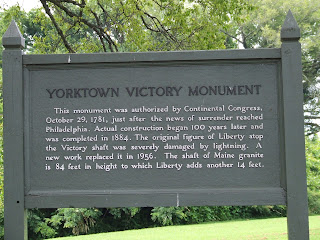
The Shuttle returns us to the Visitor Center at the Battlefield and we drive around town a bit more stopping at the Victory Monument which celebrates victory in the American Revolutionary War.  It was installed in 1884 and the rings around the spire represent the 13 original colonies. 

We then head home stopping at Dairy Queen for a shake to cool off our overheated bodies.  Boy did it taste good.  Another educational day for the Ballards.

Friday, July 17, 2015

Williamsburg

Yesterday was a day at home for us to regroup.  Today; however, we are on the road by 10:00.   It paid off as we find the parking lot at the Williamsburg Visitor Center with no real traffic and no problem finding a close spot to park.  The Visitor Center is a large facility housing a large bookstore, a gift shop, restrooms, two theaters and numerous ticket counters to purchase tickets for various venues within Colonial Williamsburg.  A beautiful waterfall cascades between beds of Coleus next to the steps which leads to the front door of the Center.


Since we only have today to walk around and four hours is probably our limit in terms of time in the Park, we opted to watch a 36 minute film in one of the theaters, to take the shuttle to the Park and not take any lengthy tours but rather to walk around at our own pace.  This did mean we would not have access to some of the buildings such as the Capitol and the Governors Home, but there were many others we could see and enjoy without taking a tour.

The film we viewed, "Story of a Patriot" has been recolored, having come out around 1957 and starring Jack Lord (remember the original Hawaii Five-0) and telling the story of the events that led up to the American Revolution.  I'm sure we studied some of this way back when, but Ron and I both benefited  from this refresher to get into the right mindset as we walked around.

The shuttle dropped us near the Governor's Palace and we walked around  the streets taking in the colonial residences, public buildings, craft shops and peaceful gardens.   Historic Williamsburg covers several square blocks and  today includes eighty-eight original buildings that have survived from the period some privately owned and resided in. While this is a popular venue, it is so large that you do not feel like it is crowded.

Th Governor's Palace when completed in 1722 was considered the finest structure in British North America.   The Palace was the home of seven royal governors and the first two state governors.
Bruton Parish Episcopal Church
Courthouse of 1770
The Capitol here represents the first Capitol which was built in 1701 and was the site of many important political events.  
A house along the roadway

 Costumed interpreters, craftsmen, candle maker, militia men and coachmen are  found everywhere explaining what is happening in their location, explaining how items are made and helping you to understand the time period and events.

To top it off, horse drawn carriages, both open and closed, roll along the streets making it necessary to watch where you walk and step.

Throughout the historic area are various taverns to enjoy a snack or meal and various shops selling items related to the period from candles, dresses, hats, toy, beer, wine and food items such as muffin mixes and preserves.  There are also activities in various places to keep the children's interests.


After completing our walk around, we catch the shuttle back to the Visitor Center satisfied that we have seen what we wanted to see and relearned some of our American Revolution history lessons.

Thursday, July 16, 2015

Jamestown Settlement and Surry County

Wednesday, July 15, 2015

It's Official!  We are homeless.  Not really, we have our home on wheels (haRVey III) and home is wherever we are.  Closed on the house on Eastford Place late this afternoon.  Yeah!  Closing was a long time coming.

Leave this morning following the signs and not the maps of the area as yesterday we had a problem with the map and the roadway not seeming to be in sync.  Leaving I-64 we followd signs leading us to the Colonial Parkway which links Jamestown, Williamsburg and Yorktown via a 23 mile scenic highway along the James and York Rivers.  Today we are visiting Jamestown and another day will take this scenic road to Williamsburg and Yorktown.


There are two Jamestown sights, one is the archaeology site (excavation continues here) and the other is the Settlement which is the living history museum close to the original site.  We opted for the Settlement since it had the most to offer in terms of learning and things to see.   The Settlement is along the James River and in a beautiful setting which was established in 1957.  The exhibit building is a long structure offering a theater, gift shop and exhibits of 17th century artifacts.

Our first stop was at the theater to view an introductory firm "1607:  A Nation Takes Root" where we learn about the establishment of the Virginia Company, who and why the English came here and what the settlers lives were like once they arrived.  It was a group of 104 English men and boys who set sail for a 5 month trip to the banks of the James River to form a settlement.  Their goal was to make a profit from the resources in the New World which never materialized as it was all they could do to survive.


Leaving the building, we walk down the pathway toward the first of the living history areas -the Powhatan Indian Village.  The Powhatan Indians were the ones living in this area at the time the English first arrived.  The Village consists of homes and outdoor activity displays.


Further down the walkway and next to the river are full size replicas of the Discovery, Godspeed and Susan Constant, the ships that brought the English here.   Costumed interpreters offer information about life aboard the ships.


The last living history area is the James Fort which includes buildings made of wattle and daub (Wattle and daub is a composite building material used for making walls, in which a woven lattice of wooden strips called wattle is daubed with a sticky material usually made of some combination of  wet soilclaysandanimal dung and straw.) and include a church, governor's house, storehouse and an armory.  


Next to the Jamestown Settlement is the highway which leads to the Jamestown-Scotland Ferry which was established in 1925 and takes cars, bikes, and people across the James River to Surry County.  We get in line and are soon aboard the Ferry and heading across.   It is a about a 20 minute ride and the ride is free.  Standing in front we watch as we head across seeing Jamestown fade away and the wharf on the other side coming in to view.


Surry County was once considered an extension of the Jamestown colony and is very rural with small town charm.  We have only a short time to spend here as we are due back to our campground in two hours for our house closing so we drive to the city of Surry taking in the Courthouse and other buildings in town


 and stopping along the way at Smith's Fort, a Plantation and Fort.  The Fort was built by Captain John Smith in 1609. The house was built on land that was given to John Rolfe by Chief Powhatan when Rolfe married the Chief's daughter, Pocahontas.  The road to the Fort was listed as hazardous so we did not venture further on to see it. 


 Return to the Ferry dock to return back to Jamestown.  A fun ride.

Return back to the campground via another road taking in more of the countryside here.

Moving and Sightseeing

Monday, July 13, 2015

Move Across the State

Today we left Waynesboro for Williamsburg.  It was an easy trip as it was only 150 miles all on the freeway. Son Bill had suggested we take the I-295 bypass around Richmond instead of going through the city.  Boy, was that a great idea as we just breezed along.

Our campsite is at a Christian Retreat Center about 12 miles from Williamsburg and we sit among the trees.  It is so dense that we see little sun though it does peak through the trees.  The Center is lovely and very quiet as there are few RV's though they do have a group of students here for a camp; however, they are across the grounds from us staying in cabins.  The Center offers a variety of activities including a nice outdoor pool.


Once we are settled in, we take a drive to get our bearings.  That turned out to be a bit frustrating especially since it was near commuter time and all the roads were very busy.  We will wait until tomorrow to do any sightseeing.

Tuesday, July 14, 2015

Charles City County, VA

Our intent today is to visit Jamestown but the attraction map and Kathy's direction get us on the wrong road and we end  up on a lovely scenic drive toward Charles City County along the James River where there are numerous old (dating back to the 1700's) plantation homes and property which are open to the public either to view the home and gardens or just the gardens.

There is no city in Charles City County and the heart of the community is its early 18th century courthouse, a link between the past and the present.  Despite being close to historic Williamsburg and Richmond, the capital, the area is very rural  with extensive timberlands, tidal waters and thousands of acres of cultivated farmland.  The area has been home to Native Americans, early settlers, planters, slaves and free blacks, presidents and signers of the Declaration of Independence.  Many of these individual's descendants still live in the area.

All along the roadway are signs telling of historic places, people and events.  Our first stop is at Sherwood Forest the plantation home of John Tyler (10th President) for whom the highway we are on was named.  Each of the homes requires a fee to see either the grounds and/or home so we aree selective about which ones we want to see.  However, we are able here to take a couple of pictures of the outer grounds, graveyard and an interesting tree in the parking lot.  The buildings at this location date back to from 1680 to 1850.  Amazing that they are still around.  John Tyler lived here in 1845 when he left the White House.


Did you recognize the guy in the picture?

After reviewing  the tour information,  we decide to tour Berkeley Plantation as it is listed as the most historic and a number of significant events happened here.  The 1726 Georgian  mansion was the birthplace of Benjamin Harrison V, a signer of the Declaration of Independence and his grandson, William Henry Harrison, the ninth President of the United States.  Also William Henry Harrison's son, Benjamin Harrison, was our 23rd President.  Of significance also is that the song "Taps" was composed here while General George McClellan used the home as headquarters during the Civil War.  George Washington and the nine Presidents succeeding him all enjoyed hospitality in the dining room here.  The roadway into the Plantation is dirt and is the original gateway to the estate that was taken by carriages.


The house sits on a beautifully landscaped hilltop above the James River and is said to be the oldest 3 story brick house in Virginia being built of brick fired on the plantation.


There are five terraced boxwood gardens leading to the River.


After watching a 20 minute video regarding the Harrison family, events here and the house, our docent takes us through the lower floor of the house as the upper story is still being used by the present owners whose earlier family was responsible for bringing the house back into repair and open for public view.

Two interesting things about the house are the cannon ball lodged in the wall of what was once the kitchen and laundry room (and possibly slave quarters) and the underground tunnel from that house into the main home.  The tunnel has not been opened but explored only by a man on a harness with a video camera.  Interesting.


Since it is late in the day when we finish here, we are only able to drive by several other Plantations taking pictures where we can  since most gates are closed for the day.  We stop at Westover House (named for Henry West, fourth Lord of Delaware and son of Thomas West, Governor of Virginia) taking pictures of the James River and one of the gateways into the property.


Further along Route 5 is the Shirley Plantation founded in 1613.  It is the home still of the Hill Carter family who live and work there today.  It is said to be the most intact 18th century estate in America.  We only get a very distant glance at part of the buildings and wish we had been here earlier to see the entire estate and home.


An interesting day despite taking the wrong road.  Everywhere we went today we saw the largest and most gorgeous crape myrtles in full bloom.  Most were the beautiful fushia (not spelled correctly) shade but some were a pale pink.  I had never seen such large ones before.  Glad we were here to see these in bloom.