Saturday, June 25, 2016

Scenic Byways and Small Towns Treasures

Thursday, June 23, 2016

Our venture today takes us up north from Boise on the Ponderosa Pine Scenic Byway to the old mining town of Idaho City and on up to Lowman.  The road winds, and I mean winds, and slowly climbs along the scenic byway in a northeasterly direction.   Along the way we pass the Arrowrock Dam where we get a beautiful view of the reservoir.


There just aren’t words to describe the beauty of the mountains and the cascading rapids of More’s Creek next to the highway that is moving the melting snow from high up in the mountains above us.  More’s Creek was named for J. Marion More who led a party of miners to Idaho City.  Part of the road they took was a toll road that led them through the lowest point in the skyline across the valley in the picture below. 


The town of Idaho City once was a thriving gold mining town of 6,000.  Today it is a sleepy little village, but on the weekends many of their stores closed today will be open for tourists.  We stop at the Visitor Center for information about the town and are pleased to find that there is info about all the old buildings.  I am especially disappointed that the Antique Store and another “Junk Store” are closed as I love to poke around in those kinds of places.  Unfortunately, our town literature did not tell us about this “Junk Store” building so I’m really not just sure what this store is about, but it looks interesting.  Do you see the bathtub on the second level out in front?  Wonder if anyone ever took their bath there in plain view?  How about the windmill up on top?  Curious.  Wonder if it catches any wind to pump water into the building?  

Our drive around town reveals many old and quaint buildings some of which have been moved to a central location.  The building I find the most interesting is “The Pest House”.  I can’t imagine what that is all about.  Fortunately, the sign and inside of the building below explain it all.


Several of the very old buildings have some furniture or artifacts in them. 


Judge Halley Home
 
Penitentiary

Fire House
Blacksmith Shop and Jail
Other buildings are just those we see along the streets.  Note that this town still has wooden sidewalks.

Church and City Hall (former School)
Note wooden sidewalk on the right picture
Leaving Idaho City, we continue north toward Lowman which is a disappointment after Idaho City.  We never find any kind of town, but do cross over Clear Creek and the South Fork of the Payette River which is rapidly moving the rippling water along its path.  Here like the Springs near Twin Falls the water is crystal clear allowing us to see the rocks below the surface. 
         Left - Clear Creek                    Right - South Fork of Payette River

The highest elevation along this road is 6,117 feet with the mountains filled with pine trees in abundance and large and small cabins appearing here and there along the way.  This elevation is low to us since we live at 5,000 feet in Albuquerque.

Traveling from Lowman west toward Garden Valley we are now on the Wildlife Canyon Scenic Byway.  There are so many different byways in this area.  Here the Payette River can be seen flowing in the canyon below.  The water here appears to be a greenish blue shade and glimmers in the sunlight. 

Before reaching the town of Banks, we suddenly spy some rafters on the river.  Quickly pull over land are fortunate to be able to see several of them rushing down the rapids.  What a thrill to watch and photograph.    Once in the town of Banks we see that this is a big rafting area as there are several businesses here offering trips.  Now turn south toward Boise with the Payette River to our west where we come upon several more rafting groups.   

We are now traveling the Payette Scenic Byway and soon reach an area that reminded us of traveling in the San Joaquin Valley of California from Gilroy, CA to Los Banos, CA through Pacheco Pass.  The area here in Idaho is rolling hills with some gold colored grasses which we used to see in that area of California.  Today, however, California is unfortunately very dry and brown.  The hills along the highway here are filled with large homes with green grass and fertile fields in abundance. 

It has been a very interesting day filled with old buildings, rivers and creeks, mountains and hills.  Idaho has thus far shown us its beauty from the semiarid to the fertile fields to the mountains and rivers.  What more will she show us in the weeks ahead as we travel further north?

Friday, June 24, 2016

Our trip today was a short distance compared with the over 100 miles of yesterday.  We go west from Boise on back roads that take us through the farm and wine country headed for the town of Caldwell.

In 1882 Caldwell was selected as a new town site for the Oregon Short Line Railroad and became incorporated in 1890.  Early photos show the area as a sagebrush covered desert with hardly a tree in sight; however, the arrival of irrigation water opened it up to becoming fertile  farm land as well as making it a center for commerce and business.  Since 1971 Caldwell and other surrounding cities have become a fast growing and unique grape and wine industry area.

Driving along one of the main streets I see an Antique store so of course Ron must stop so I can see what treasures they have to offer.  Living in the RV limits just how much “stuff” I can collect, but I do enjoy browsing.  I never know when a treasure will appear and I can’t live without it.  

Later on we come across the “Emporium” and its sister store across the street with me purchasing a book in each store (the item I purchase the most in antique stores) and Ron finding his first “treasure.”  As you all know, he is not one for shopping, but he couldn’t pass up a golf bag with attached legs that holds the bag upright when set down and for only “$12.50.”   What a bargain since after opening all the side pockets back at the RV, he found two dozen golf balls, a large bag of tees, two golf gloves, a golf towel and several more miscellaneous golf related items.  This treasure was hiding just inside the front door but he did do his cursory looking through the rest of the store before making this purchase.  Now he will have to find a home for his existing golf bag and rolling stand.  Maybe it can find a new home and be some else’s “treasure.” 

We found this old brick train depot with baggage cart where the street leading to it had been closed off and planted with grass.  Just in front of the depot were water spouts where a young child was having fun running through them on this warm afternoon.  On each side of the closed off street were buildings with the side of one having several lovely flower enclosed designs along the wall.  Not sure what the purpose was.  


A row of old commercial buildings includes this one with the name “Steunenberg Building” on it.  Don’t you always wonder who the people were whose names appear on buildings in towns?  I do.  In this case, there was a stone monument near the train depot with pictures of two Dutch brothers named Steunenberg who established the first newspaper in Caldwell.  That answers that question. 
                                     Local Clock Tower                                         Scheunenberg Building                                                          


We also found this cute mural near the depot on the back wall of a local business which alighting passengers from the train would be sure to see.


In an old residential area we find the local museum (Our Memories Museum) housed in what used to be the local doctor and dentists office building.  The Museum purchased the building which also included the old doctor and dental equipment as well.  Quite a treasure.  The Museum is quite interesting with 30 different exhibits with each room set up as a room in a house or business (dental office, barber shop, beauty shop, etc).  There were also some lovely old hand quilted quilts hanging on the walls which I really enjoyed viewing.  This was one of the nicer small town museums we have seen with lots of history of the town and local artifacts depicted within. 

Back to Boise and the RV with just two days left to sightsee in this area.  Not sure yet what we will do, so stay tuned.

Friday, June 24, 2016

Boise, ID

Monday – Wednesday, June 20-23, 2016

June 20th was our 18th anniversary.  Happy Anniversary, Ron.  Can’t believe we have had that many wonderful years together.  I look forward to many more years with you and traveling in the RV enjoying all the beautiful places this country has to offer us.

Our trip on Monday from Twin Falls was uneventful and very short.  Only 129 miles to Boise via I-84 through some very fertile but also dry areas with mountains in all directions though not very high ones.  Our campground was a bit tricky to find, but what really happened was we missed the sign since mapquest indicated we were to go 1/10 of a mile beyond where we were supposed to turn.  Of course, this meant finding a place to pull over and turn around.  It’s always a challenge to move across lanes of traffic in an unfamiliar place, turn around or having to drive down narrow residential low tree lined streets with 40 feet of RV plus a car on the back, but Ron does a great job of getting us through those tight spots. 

Our campground here is located next to the Western Idaho Fairgrounds and a bike/walking path which runs along the river behind the campground and Fairgrounds.  This heavily wooded trail, called the Boise Greenbelt, runs across the city for 27 miles and is used by lots of bicyclists and walkers who use the trail to bicycle to work, exercise or just enjoy a day out with nature.  Many places along the way give you a view of the swiftly flowing river through the trees.  I have enjoyed early morning walks along the trail listening to the sounds of birds and the river.  What a joy to be spending time outdoors this summer.  Weather here, while so far fairly hot during the day (in the low 90’s these last three day), does cool off in the late afternoon with pleasant evening temps but cool nights (low to high 50’s).

Boise is called “the City of Trees and the name Boise means “wooded.”  It is the state capital as well as the largest metropolitan area in the state founded in 1863 a year after the gold rush reached the Boise Basin.  The woods lining the Boise River were a grateful sight to the French-Canadian trappers after trudging across the eastern territory’s semiarid plain.    Today the population in Boise is over 200,000. 

Boise has a number of large Parks one of which is the Julia Davis Park which is the cultural and historic heart of the city containing a number of museums, the zoo and a rose garden.   The Park was created in 1907 and named in memory of Thomas Jefferson Davis’ wife Julia.  Davis was granted a homestead of 360 acres and was responsible for laying out the plot of Boise

Our first stop at the Park was the Idaho Black History Museum which is housed in the historic St. Paul Baptist Church building and whose purpose is to build bridges between cultures.  Numerous plaques with text and pictures gave us a history of the black people in Idaho.  Very interesting and informative. 


Unfortunately, the Historical Museum was undergoing renovation and we were only able to photograph these three old homes from Boise on the grounds of the Museum.  The area was fenced off and we were not able to identify whose homes they had been.


Before returning to our car, I strolled through the beautiful rose garden and along the walkway under the canopy of trees where I found picnic tables, benches and lush green grass as well as these sculptures depicting Julia Davis handing an apple to a child. 


I did not find too much to see in the city from my literature; however, after spending a morning riding the Boise Trolley, we learned different.  The hour and a half ride took us through the downtown area, the historic home district, and some outlying areas including a drive by the Old Idaho Penitentiary State Historic Site which I will mention again later.  We have been in many large towns, but I do not believe we have ever seen as many large old homes, craftsman styles or other early 1900’s homes as we have seen here.  The historic district was quite extensive. 


 Before arriving at the Old Idaho Penitentiary, we stop at this old Trolley Station which today is a cute restaurant serving breakfast and lunch.   Note the painting on the side of the building.


The Old Idaho Penitentiary located a bit out of town near the mountains was used from 1870-1973 with additions to the complex constructed by the prisoners with sandstone they quarried and cut.  We missed the last tour so walked around on our own strolling through several buildings including the maximum security building and noting information regarding various inmates and listening to a video recalling prison history and conditions of prison life.  The grounds and rose garden are still maintained as they were by inmates in the early 1900’s.  Some of the cells held two prisoners and a few held four.  

                                                     Admin Building

Cellblock Buildings

Maximum Security Building

Top - Prison Gardens, Bottom - Back of Admin
Right - Guard Tower as Seen From Outside Walls  of Prison
I don’t believe life here would have been very pleasant though the guy in the picture below does not seem too concerned. 
                                                                      Do you know this Prisoner?
One evening Ron’s nephew, John who lives and works in the area treated us to dinner at a place called Bardenay Restaurant and Distillery.  This is a vodka distillery..  We were seated on the outside patio  located along the Boise River under the shade of a large umbrella, not really needed at this time of night with the sun already hiding behind the building but certainly welcome earlier in the day.  While we did not sample the vodka, we did enjoy a good meal and catching up with John whom we have not seen for several years.  Thank you, John.  It was good to see you.


Sunday, June 19, 2016

Last Days in Twin Falls

Saturday, June 18, 2016

Today Ron and I are going to visit a friend of ours who lives here in Twin Falls.  Back in 2011 when Ron and I were vendors, we met Gordon and Susan Harris who were Idaho Good Sam State Directors.  They asked us to come to their Samboree here in Idaho the next year.  We attended the Samboree as vendors and then traveled to Twin Falls to take in the sites.  Gordon and Susan graciously took us up to Sun Valley, Stanley, the Hemingway Memorial and Redfish Lake where we spent a wonderful day enjoying the sites and getting better acquainted.  We have kept in touch ever since but not had a chance to get back up here until now. 

For the past two years Gordon had been suffering with pancreatitis (a disease we know about first hand since Ron had the same thing back in 2002).  Unfortunately, Gordon lost his battle with this terrible disease in February.  We were so sad to learn of his passing and want to spend some time with Susan offering our sympathy and support as she goes through this difficult time without Gordon. 

Since Gordon was a charter member of the Model Railroad Club here at the Fairgrounds, Susan asked us to stop by the building to see what Gordon had been involved with and to see his trains.    The two gentlemen working in the building this morning mentioned that they missed Gordon’s presence and took the time to show us Gordon’s trains which are still on display.


We picked Susan up at her house and went together to have dinner at a local restaurant.  What a wonderful visit we had catching up on things since we last saw each other, talking about Gordon and their life together  and observing how well Susan is doing.  She is a strong woman and is already doing very well on her own.  It was wonderful to see you, Susan.  We look forward to keeping in touch and hopefully seeing each other again one of these days.  What wonderful people you meet on the RV road. 


Sunday, June 19, 2016

Happy Father’s Day to all the Fathers in our family – My wonderful husband, Ron Ballard, Kent’s father; my children’s father, Wilbur Birchler, the father of Bill and Laurie; my son Bill Birchler, the father of Ariana and Sarah; my son in law, Kyle Taylor, the father of Kaylee and Garrett; my nephew, Matthew Avellar, the father of Carson; Kyle’s Dad, Robert Taylor; and my Dad, John Avellar ; my brother Jack Avellar, Matthew’s Dad; Ron’s Dad, John Bickford;  and my daughter in law Lisa’s Dad, John Franchini, the last four all deceased though nonetheless very missed.   Thank you for being the great Dad’s you all were and are. 

Today is our last one in Twin Falls and we have just spent it relaxing, cleaning the RV and doing a bit of shopping.  I have not mentioned anything about the city of Twin Falls so thought I would include some info and pictures of attractions taken on a previous trip.

Twin Falls, located in the south central part of Idaho, has long been the center of 500,000 acres of prime farmland irrigated by the Snake River.  It has been known as one of the nation’s most prolific crop producing regions.  The city sites atop the basalt cliffs some 486 feet above the Snake River Gorge and is obviously very rural. 

The city is on the south side of the river and the freeway on the north so one is crossing the river to get into town and to leave.    The Perrine Bridge is a four lane bridge with a pedestrian walkway that allows you a view of the cliffs and river below.  

Perrine Bridge
This is the only place in the United States where BASE jumping from the bridge is legal every day of the year without a permit.  Jumpers from all over the world jump off this bridge which is 475feet above the Snake River in the gorge.  We park in the Visitor Center and walk under the bridge to the east side where others like us are watching the people on the far side of the bridge getting ready to jump.   Several minutes pass before we see two different jumpers leave the bridge.  Below on the ground is a target which the jumpers are aiming for and manage to arrive at.  Below there is also a boat, presumably waiting to pluck a jumper from the river should he/she miss the target and land in the water.  Exciting to watch but not to try.

  
Leave the Bridge to drive down another steep road to Centennial Park (owned by the city of Twin Falls) and a golf course.  A lovely park with covered picnic tables and a view of the river nearby.  We can also see the Perrine Falls which drop down from high up on the side of the cliff.

Perrine Falls
Signing off until we reach Boise

Saturday, June 18, 2016

Minidoka National Historic Site

 Friday, June 18, 2016

Yesterday I mentioned that we had learned that there was an old Japanese Internment Camp just to the east of the town of Jerome.  So today we took a drive out to see what was there. 

Many years ago I read the book called “Manzanar” which is the name of a camp located in the California Mohave desert.  As it turned out, I worked at that time for a Japanese lady in Los Alamos who was born at one of these camps.  As a result I have always wanted to visit one of these camps to learn more about the lives these “American Citizens” and aliens were forced to endure as a result of their incarceration.  I know that my boss had some real resentment even though she was but a baby when her family left their camp.  After what I have seen and read, I can hardly blame these people for their feelings.  

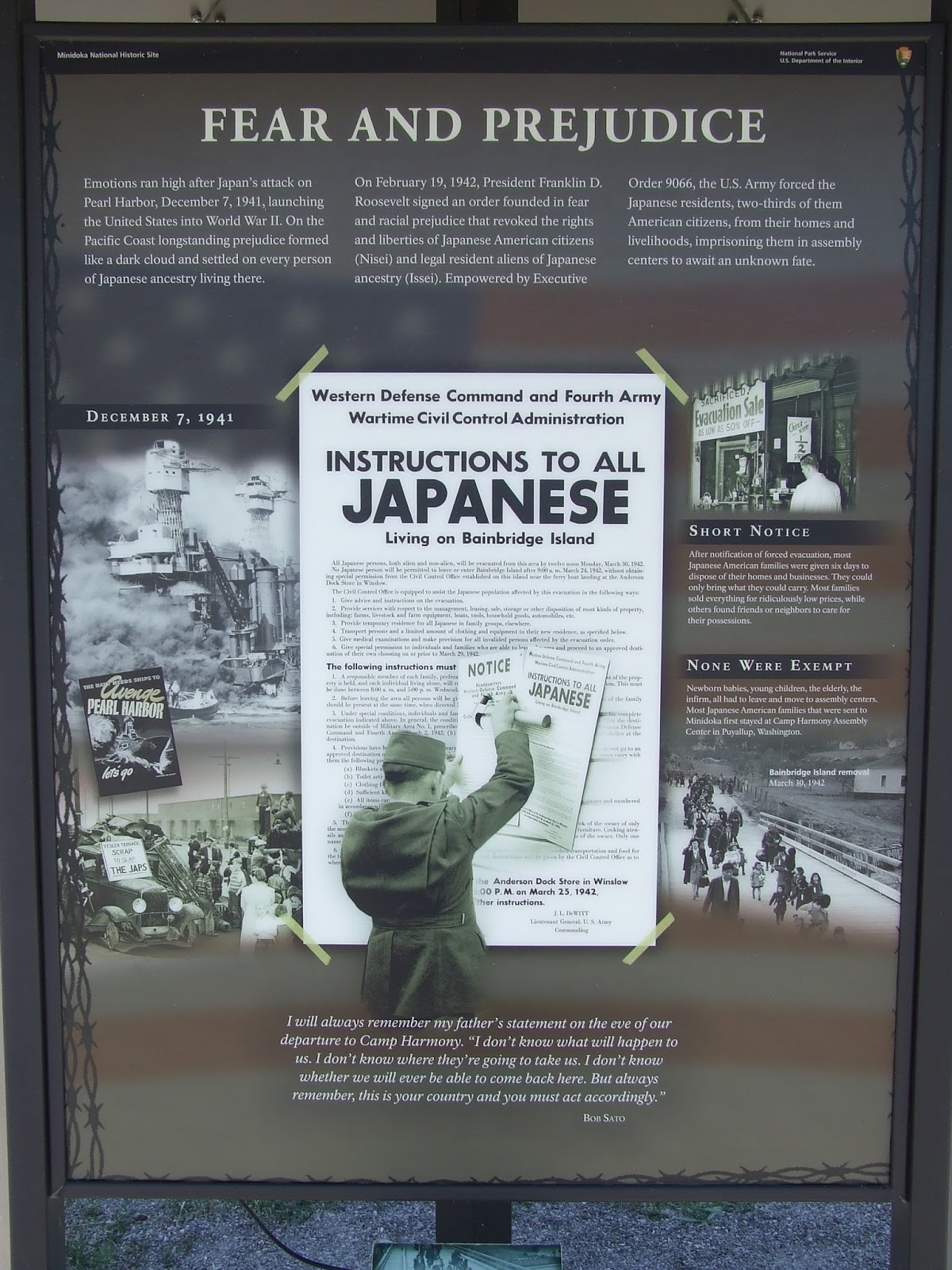
My parents lived in San Francisco during the War, but I don’t ever recall hearing any comments made in our family about the Japanese people at this time even though there were many, many of them living in California at that time.  I realize that I was not old enough during the War to know about the “fears and prejudice” people had during that time, but I find it appalling today to think what our country forced these American Citizens to endure.


In February 1942, President Franklin Roosevelt signed Executive Order 9066 which deprived 110,000 people of their freedom.  All were of Japanese ancestry with 2/3 American citizens and half children.  These “citizens” were required to close their businesses, shut down their farms, and pack their suitcases to board trains and buses to be taken first to detention centers and later to prisons.  For the remainder of the War they would lead bleak lives while remaining behind barbed wire far from their previous homes.   There were 10 such Camps all in the Western half of the U.S.  

This site here in Idaho is today called Minidoka National Historic Site and is located 10 miles out of the closest town and at the time of the internment was nothing but dry arid land; however, having a canal running through the area provided solace for these people from the Northwest part of the country (Oregon and Washington) where water was a part of their life.  


Sign found on Highway leading to the Camp
Canal running within the Camp property
13,000 people were imprisoned with a peak population in 1943 of 9,397.  While the eight guard towers at Minidoka were never completed or manned, barbed wire did surround the area giving the residents the feeling of prison. 


Right - recreated guard tower

Upper Left - Part of Military Police Building
Bottom - Guard Tower never completed or manned
Right - Reception Center 
This camp, like many others like it, were not completed when the families arrive and buildings consisted of 600 tar paper barracks crowded into 946 acres with thin walls that were not weather proof at a time when the weather was becoming the least inclement (winter was coming on).  More barracks, furniture and other necessities were soon built by the residents along with mess halls and other buildings.  The residents helped with a farm labor crisis in the area by planting and harvesting as well as planting crops within the facility to make it self sufficient.   


An Outline of the Camp Buildings
After the War, 19,000 Japanese American soldiers were awarded the Congressional Gold Medal, many of whom had families living in these relocation camps.  Here at Minidoka, a Honor Roll plaque was erected with the names of the soldiers from Minidoka who served in many different branches of the military.  A lovely garden once stood in front of this plaque.  


Honor Roll Plaque
In 1945 a Supreme Court decision said that U.S. citizens could no longer be confined.  Minidoka closed on October 28, 1945 becoming a large ghost town as residents returned to their former homes, to different communities and rebuilt their lives and/or began new lives outside the confines of the Camp.  Many never talked about their time in these camps but as the years have passed many have opened up about their experiences.

Today this Minidoka has a building in the process of restoration for a Visitor Center.  The grounds are now a National Historic Site and there are many plaques, etc. telling the story about the Site and reminding us what can happen when other factors supercede the constitutional rights guaranteed to all citizens and aliens living in this country. Below are some of the buildings still in existence on the property. 


Picture of Warehouse Bldg. and Foundation of Such

Barracks Building

Left - Motor Repair & Tire Repair Building
Right - Storage Building

Top Left - Fire Station and Hermann House
Top Right - Barracks Buildings
Bottom - Baseball Field
A quote from President Franklin D. Roosevelt in 1943 sums it all up for me. “Americanism is a matter of mind and heart.  Americanism is not, and never was, a matter of race and ancestry.”   Let us not forget this as we go forth with our lives today.

Signing off until tomorrow's activities

Friday, June 17, 2016

Shoshone Falls and Cities to the North

Wednesday, June 15, 2016

Today we did a bit of backtracking heading 40 miles east from Twin Falls to take in the small town of Rupert, Idaho which was established in 1906.


Our information said that they had a very historic downtown which piqued our interest.  While we have seen many more interesting places, we did come upon the Wilson Theater on the historic town square that was built in 1920 and was the dream of a couple named Daniel Ward and Mennie Wilson who envisioned a beautiful and unique opera house.  The theater opened on August 25, 1920 and quickly became part of the Haris-Voeller Theater chain.
Wilson Theater 1920


It became listed on the National Register of Historic Places in the late 1990’s.  During its early history, the theater played host to vaudeville, musical performances and movies. 


Across the street from the theater I spied The Gathering Place which looked to be a quilt shop.  Entering the shop, I was completely surprised to find room after room of fabric, notions, quilts, etc.  Come to find out this is Idaho’s largest quilt shop with 14,000 (yes, that is the right number) bolts of fabric in every color and design you can imagine.  I could have spent all day in the shop but Ron was waiting in the car so I made a quick selection of fabric to go with some I bought in Salt Lake and quickly exited.  I wish I lived closer so I could return time again to this shop.  What a fabulous place.


Turning back toward Twin Falls, we make an interesting side trip to the town of Hansen to see Rock Creek Station (the first trading post along the Oregon Trail) and Stricker House. The Museum “covers the story of the Rock Creek areas from prehistoric times through the development of irrigation in the area with special emphasis on transportation themes and the story of the Herman and Lucy Stricker family who settled there in the 1870’s.”South Central Idaho became a major thoroughfare for emigrants on the way to Oregon between 1840 and 1860.  Rock Creek was just one of many stations along the way.


Across the road and up a path is the Stricker House which the caretaker opened for us explaining that there are two front doors to the house.  There is a private parlor and to the back of the room was the master bedroom of the house.  Entering through the main front door was the front room and to the far right was a bedroom behind which is the butlers pantry.  To the back of the room was the dining room and kitchen furnished with a table that sat 10 people and built in cabinet for dishes and linens.  The room was quite large and had large windows overlooking the yard beyond.  The stairway from the parlor area had very steep steps and was curved at the top.  Upstairs were 5 bedrooms each furnished with period furniture, bedding and clothing of the period.  The house was built around 1901 after a fire destroyed the original house.  All the woodwork in the home is made of ash and in the style seen in most homes of the same period.

Thursday, June 16, 2016

Our first stop today was to the Shoshone Falls in Twin Falls located on the Snake River.  The Falls are called the Niagara Falls of the West as they tumble 212 feet to the canyon floor – more than 50 feet further than the famous falls on the New York-Ontario border.  The forces that created this area are eroded basalt cliffs which are relics of the Bonneville Flood, “a catastrophic torrent that ripped through the canyon about 15,000 years ago.”  (Boy, is that a long time ago.)  In  932 Richard J. and Martha Stone Adams donated the Shoshone Falls park to the city of Twin Falls with the stipulations that the land be maintained as a public park and for the benefit and use of all people.  The Falls are truly beautiful and take your breath away.  The best time to see them is in the spring as the water is diverted later in the year to produce hydroelectric power and irrigate Idaho’s very fertile farmlands. 


Looking west down the Snake River
In 1974 Daredevil Evel Knievel attempted to jump the Snake River Canyon near the Falls in a rocket powered “motorcycle”.  Today the only evidence of that event is the dirt ramp which can only be seen from a distance.

Leaving the Falls area, we head north to the small town of Shoshone, a town which had long been considered the main railroad station in the Idaho Magic Valley region.  (More about the name “Magic Valley” later on.)  Apparently Twin Falls never developed a strong railroad presence due to the logistics presented by its location south of the Snake River Canyon.  For many years, Shoshone was the only Amtrak stop in this part of Idaho.

The town of Shoshone can be found with the railroad tracks dividing the main street of town.
Painted Mural on Side of Building                                                  Railroad Station

An old hotel and

Old Hotel
some old stores  are what constitute the main part of this old community.

On a back street we come across an old Masonic Hall as well as a couple of old homes and a quaint church.

Old Masonic Hall and side of building.  Note the unevenness of the bricks.


Turning back toward Twin Falls, we stop in the town of Jerome where we find a small town Museum and learn about the Japanese Internment Camp (Minidoka Relocation Center) which was located about 17 miles to the east.  We will travel to the site another day.  

For the benefit of those who want to know where the name “Magic Valley” came from (including me), here is the info from the internet.  The name "Magic Valley" is a reference to the construction of Milner and Minidoka Dams and a series of irrigation canal systems on the Snake River during the first decade of the 20th century. In a short time these projects "magically" transformed what had been considered a nearly uninhabitable area into some of the most productive farmland in the northwestern U.S. Many cities and towns in the region were founded between 1900 and 1910 as a direct result of these projects.”

Signing Off Until tomorrow in Twin Falls